
When two vehicles collide, the outcome is never arbitrary. Every crushed bumper, shattered windshield, and deployed airbag is the direct mathematical result of fundamental physical laws. While drivers intuitively understand that traveling faster or driving a heavier vehicle increases the severity of an accident, few appreciate how rapidly impact forces escalate once kinetic energy takes over.
In forensic accident reconstruction, understanding the mechanics of a crash requires stripping away subjective accounts and analyzing the core variables involved: mass, acceleration, momentum, and energy dissipation. By applying classical Newtonian mechanics, crash investigators can precisely calculate pre-impact velocities, evaluate structural integrity, and determine exactly how energy transformed during a impact event.
Kinetic Energy: The Exponential Threat of Velocity
The single most influential factor governing the severity of a collision is velocity. However, impact force does not scale linearly with speed—it scales quadratically. This relationship is governed by the basic physics formula for kinetic energy:
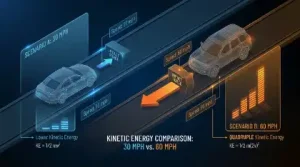 In this equation, KE represents Kinetic Energy, m represents the mass of the vehicle, and v represents its velocity. Because velocity is squared, doubling the speed of a vehicle does not simply double the kinetic energy it carries into an impact; it quadruples it. Tripling the speed increases the energy ninefold.
For example, a 3,500-pound sedan traveling at 60 mph possesses four times the kinetic energy of the exact same sedan traveling at 30 mph. During a collision, that massive block of energy must be instantly dissipated through structural deformation, heat, sound, and the movement of the involved vehicles. This exponential surge explains why a minor increase in highway speed leads to exponentially catastrophic structural damage and occupant trauma.
Mass Mismatch and the Conservation of Momentum
While velocity dictates energy density, vehicle mass dictates how that energy is distributed between colliding bodies. Under Newton’s Second Law of Motion ($F = ma$) and the Law of Conservation of Momentum, the total momentum of a system before a crash must equal the total momentum immediately after.
When two vehicles of equal weight collide head-on at identical speeds, they experience similar decelerations and dissipate comparable amounts of force. However, when a mass mismatch occurs—such as a 6,000-pound full-size SUV colliding with a 2,800-pound compact hatchback—the lighter vehicle absorbs a disproportionate share of the crash energy.
- Velocity Delta: The smaller vehicle undergoes a far higher rate of momentum change ($\Delta v$), resulting in violent deceleration or even instantaneous reversal of direction.
- Force Transfer: Because the heavier vehicle possesses substantially more momentum, its occupant compartment slows down more gradually, shielding its passengers from the extreme G-forces forced upon the occupants of the lighter car.
According to research by the National Highway Traffic Safety Administration, vehicle weight differentials remain one of the primary indicators of injury severity in multi-vehicle incidents, consistently overriding many built-in safety features of smaller passenger vehicles.
Impulse and Deformation: Extending the Time of Impact
To evaluate how energy impacts the human body during a crash, physical investigators look at the concept of Impulse. Impulse represents the change in momentum and is defined as force multiplied by the duration of time over which that force acts:
If the time of impact ($\Delta t$) is extended, the overall peak force ($F$) experienced by the vehicle frame and its passengers decreases. This single physical principle forms the engineering basis for modern automotive safety design, specifically crumple zones.
Older vehicles built with rigid, non-yielding steel frames transferred crash energy directly to the cabin almost instantaneously, resulting in low vehicle damage but lethal G-forces transferred to the occupants. Modern crumple zones are engineered to deform intentionally, buckling under controlled collapse. By extending the duration of the impact by mere milliseconds, the peak force is drastically reduced, preserving the integrity of the passenger safety cell.
How Forensic Engineers Reconstruct Crash Physics
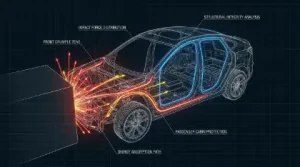 In the aftermath of an accident, reconstruction specialists utilize physical evidence left at the scene to reverse-engineer the physical forces at play. Key physical evidence includes:
- Skid Marks and Tire Friction Coefficients: Measuring the length of tire marks allows investigators to determine pre-braking speed using the drag factor of the asphalt surface.
- Crush Energy Analysis: By measuring the precise depth and volume of vehicle body deformation, engineers map the structural displacement against known barrier crash test data to establish total kinetic energy absorption.
- Post-Impact Trajectory: The final resting positions of the vehicles, combined with scatter patterns of debris, provide the exact angles of momentum vector deflection.
By compiling these variables into complex mathematical models, reconstructionists can definitively establish whether excess speed, improper braking, or structural failure was the primary contributing factor to a collision.
Every vehicular crash is a physical event bound strictly by the laws of energy conservation and momentum. By analyzing speed vectors, structural deformation, and vehicle mass, crash analysis professionals cut through speculation to uncover the objective truth behind complex highway incidents.