
When dense fog, sudden black ice, or heavy downpours blind a major highway corridor, the result can be catastrophic: a chain-reaction collision involving dozens—or even hundreds—of vehicles. In emergency services, these chaotic environments are classified as Mass Casualty Incidents (MCIs). Within the critical window known as the “Golden Hour,” the efficiency of early scene management dictates whether survivors receive life-saving medical interventions or succumb to secondary scene hazards.
Managing a massive pileup requires far more than basic firefighting or ambulance deployment. It demands strict organizational discipline, rapid multi-agency coordination, and rigid adherence to established command structures. When hundreds of lives and hazardous materials are scattered across several hundred yards of interstate, the first 60 minutes determine the trajectory of the entire rescue operation.
Minutes 0–15: Establishing Command and Securing the Perimeter
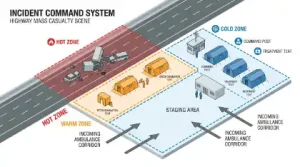
The initial response unit arriving at a major highway pileup faces visual overload: crushed passenger cabins, leaking fuel, displaced cargo, and injured motorists walking blindly through active traffic lanes. The immediate priority for the first arriving officer is not physical extraction, but establishing structural control.
Under the framework standardized by the Federal Emergency Management Agency through the Incident Command System (ICS), the primary officer assumes the role of Incident Commander (IC). Before committing personnel to extrication, the IC must immediately execute critical operational steps:
- Size-Up and Windward Approach: Assessing the geographical footprint of the crash, estimating total vehicle counts, and evaluating potential hazardous material spills from commercial haulers.
- Traffic Control & Secondary Protection: Positioning heavy engine apparatus diagonally across lanes (“fending-off”) well upstream of the collision to protect working responders from secondary high-speed rear-end impacts.
- Establishing Control Zones: Defining the Hot Zone (immediate hazard/extraction area), Warm Zone (triage and decontamination), and Cold Zone (staging and command post location).
Failing to establish command within the first 15 minutes leads to “freelancing”—where incoming units operate independently without unified strategy—increasing the risk of responder casualties and chaotic radio traffic.
Minutes 15–30: START Triage and Medical Prioritization
Once the perimeter is hardened and incoming fire, EMS, and law enforcement units are directed to staging areas, the focus shifts to rapid patient evaluation. In a multi-vehicle pileup, medical assets are initially overwhelmed by the sheer ratio of victims to responders. First responders utilize the Simple Triage and Rapid Treatment (START) algorithm to categorize victims based on physiological stability in under 60 seconds per person.
Triage teams move methodically through the wreckage, tagging patients with standardized color-coded systems:
- Red Tag (Immediate): Critical injuries involving airway compromise, severe hemorrhage, or shock. These patients require immediate evacuation once extricated.
- Yellow Tag (Delayed): Serious injuries such as closed fractures or moderate burns, where treatment can be delayed briefly without imminent loss of life.
- Green Tag (Minor): The “walking wounded” who are capable of moving under their own power. These individuals are promptly guided to a designated safe shelter area in the Cold Zone to clear the extraction corridor.
- Black Tag (Deceased/Expectant): Victims with injuries incompatible with life, allowing responders to preserve limited medical resources for viable survivors.
By establishing clear medical prioritization during this window, EMS leaders ensure that heavy hydraulic rescue tools (the “Jaws of Life”) are deployed to vehicles holding Immediate status victims first.
Minutes 30–45: Extrication Vectors and Hazard Mitigation
Extrication at a multi-vehicle crash is fraught with severe physical hazards. Crumpled metal structures under tension can shift unpredictably, battery systems from hybrid or electric vehicles present high-voltage fire risks, and leaking fluids create explosive atmospheric conditions.
Technical rescue teams implement heavy stabilization protocols prior to initiating sheet metal cuts or roof rolls. High-pressure air bags, mechanical struts, and winch lines are used to lock tangled vehicle frames in place. Simultaneously, fire suppression crews deploy charged hose lines over working extrication teams to mitigate flash fires triggered by sparks near ruptured fuel tanks.
Because multiple rescue crews operate concurrently across a wide geographic debris field, the Operations Section Chief coordinates rescue divisions to ensure heavy equipment access paths remain open, preventing ambulances from becoming boxed in by arriving service vehicles.
Minutes 45–60: Patient Transport and Scene Stabilization
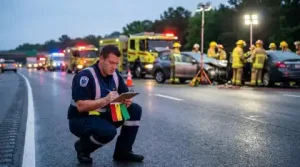
As the first hour draws to a close, the primary operational focus shifts from search and extrication to structured medical transport and scene containment. The Transport Officer communicates directly with regional trauma centers to distribute critical patients evenly across regional hospitals, avoiding the catastrophic overcrowding of the nearest facility.
Advanced telematics, aeromedical helicopters, and regional emergency management software coordinate air and ground transport vectors in real time. Once all living victims are cleared from the Hot Zone, the incident transitions from an active rescue operation to a controlled forensic investigation and road clearing effort led by highway patrol crash reconstruction units.
The survival rate of victims involved in major highway pileups relies directly on the systematic discipline executed during the first 60 minutes. By transforming chaotic crash scenes into organized, command-driven environments, first responders systematically defeat time, hazard, and distance to save lives.